

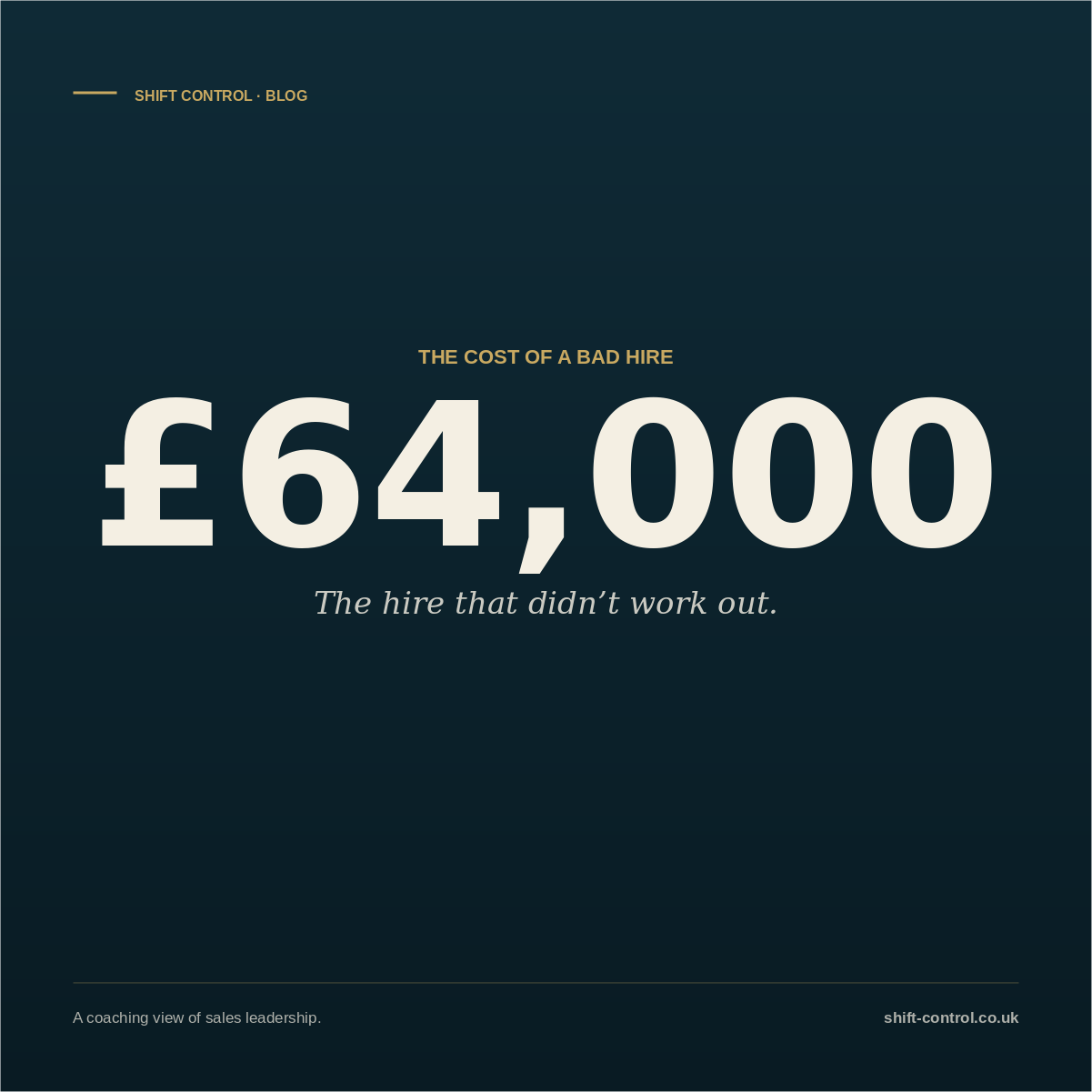
The Hire That Cost £64,000 (And the Conversation That Could Have Saved It)
I asked a room of sales leaders earlier this year what their biggest challenge at work was. The answer came back without much hesitation: recruitment. Finding people. Keeping the ones worth keeping. Replacing the ones who left.
In the north of Ireland, with a pool this size and competition for sales talent now reaching in from other territories, that’s the answer you’d expect. It’s also the answer that hides the real problem.
The scene every sales leader will recognise
Here’s the scene most sales leaders will recognise. Someone leaves, or growth outruns capacity, or the three-year plan needs another pair of hands. HR is asked to get an advert out fast. The last advert gets dusted off, the closing dates updated, the salary line quietly removed in case anyone in the team is on less. A seat needs filling. Speed wins.
Three months later you have a new hire with a small portfolio of “teeth-cutting” accounts, a half-finished onboarding plan and a pipeline that looks more like a rumour than a forecast.
What follows is a brief look at the cost – visible and invisible.
The £Available-on-Request salary in the advert was £38,000 base, £55,000 OTE. By the time you sit down with your management accounts six months later, the visible costs look like this:
- Salary paid: £19,000
- Employer costs: £3,800
- Tools of the trade — hardware, software, phone, laptop, car: £2,500
- Onboarding and internal training: £3,000
- Recruitment fee: £5,700
The visible cost: £34,000
Now the invisible. A competent sales hire in this market should be carrying a £250,000 pipeline and £1,000,000 in committed orders by month six. Yours generated weak activity, thin conversations, almost no follow-up, and a pipeline you wouldn’t show the board.
Conservatively — and I mean conservatively — that is £25,000 in lost gross profit. Add your own time and your colleagues’ time managing the situation. Call that £5,000.
The quantifiable invisible cost: £30,000
Running total: £64,000.
And then there is the part the spreadsheet cannot carry. The hit to team morale. The quiet recalibration your best performers do when they watch a bad hire be tolerated. The customers who met the wrong person and stopped returning your calls. The two or three prospects in your market who now think you don’t quite know what you are doing.
And then — because the seat is empty again — you do the whole thing over.
It isn’t a recruitment problem.
It is easy for me to say “pay more” when the money isn’t coming out of my pocket. It is easy to gloss over the disruption an honest conversation about pay parity would create. Neither of those is the lever I would reach for first.
I would argue that the pattern outlined at the start of this piece, is not really a recruitment problem. It is a leadership problem.
The hire goes badly because the brief was never properly written. Because nobody decided what good actually looks like in this role before the advert went out. Because the onboarding plan was a calendar invite rather than a system – a clearly defined process that goes beyond a laptop, a phone and a company car.
Because the person doing the hiring has never been asked the questions that would have surfaced any of that.
Sales leaders are very good at coaching their teams to win deals. They are rarely coached themselves. The bad hire is almost always a downstream symptom of that gap.
Investment goes into product, into plant, into process, into the service. All necessary. None of it makes up for the cost of putting the wrong person in front of your best prospects, then having to do it all again six months later.
If the last hire you made didn’t quite work out, the question worth sitting with isn’t “where do we find better people?”
It is “what did I not see clearly enough nine months ago, and who is helping me see it next time?”
Thanks for reading