

How to build a sales process for your business
“One of the things that I love is focusing on the process over the prize. I would say to myself a lot: ‘Process over prize. Process over prize. Process over prize.’ Just to take myself away from the outcome. The outcome will ultimately happen if you just focus on the process. It takes care of itself.”
I’m writing this at the start of day 2 the 2026 US Open and it will be interesting to see how much Rory McIlroy calls on the mantra that has served him so well in his chase for major glory.
It might not have been part of his set-up in the early years but he has often spoken about his need to detach himself from the outcome.
This is something that plagues salespeople of any standard: not just too much attention on the outcome, but the inability to stick to a process.
Those businesses that succeed at the growth stage usually do so because of the processes they have in place across their business.
Scaling a business is made almost impossible without a robust sales process and in many cases sales remains the domain of the business owner to the point of failure.
Sales growth is not achieved by working harder, putting in more effort or doing longer hours.
No process, no progress
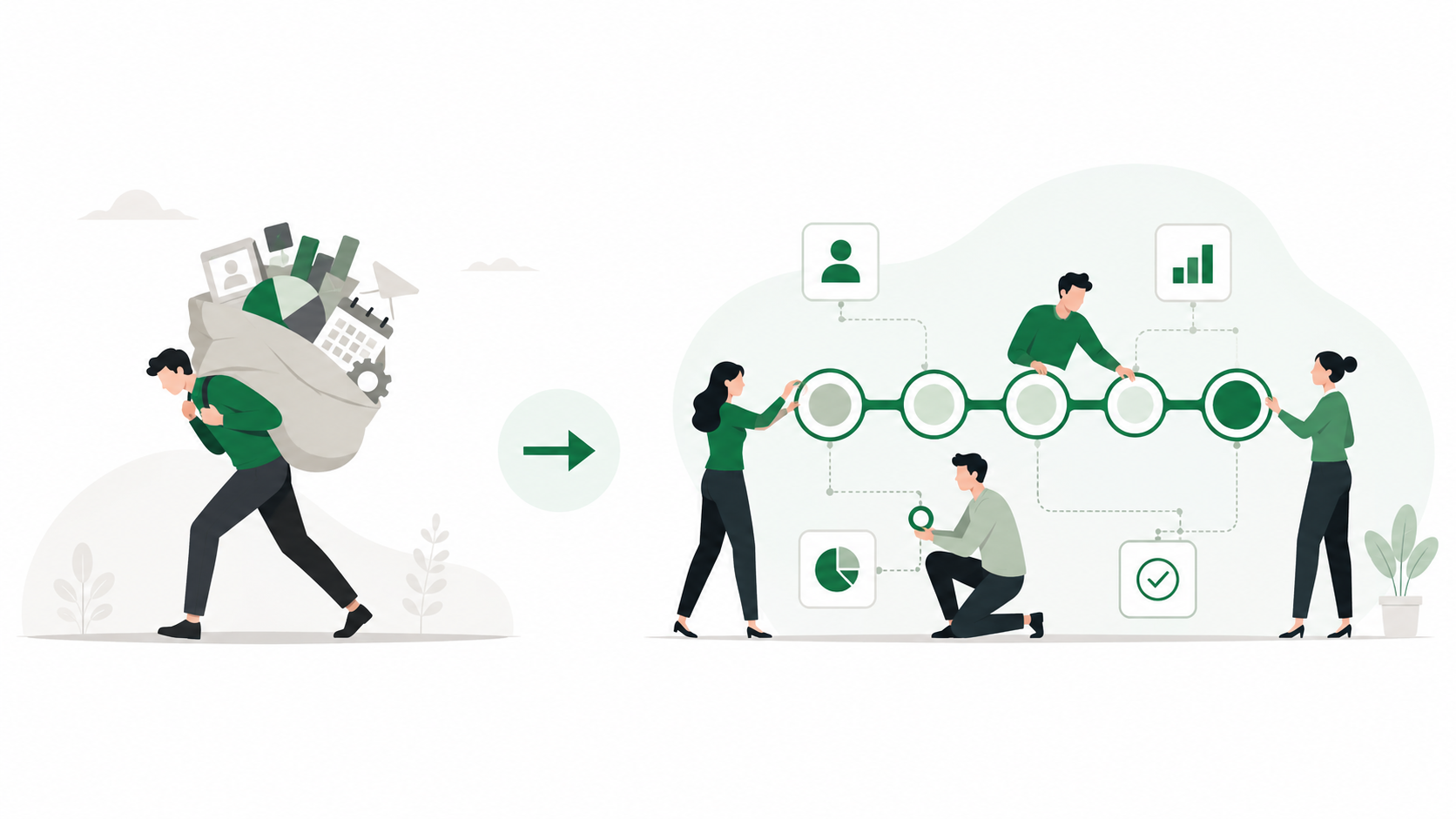
In this context, a process is a clear set of steps that anyone or a team can easily follow without the owner present. Because, contrary to what most owners believe, they don’t need to be in the middle of every deal, proposal, negotiation or handover.
A sales process is not bureaucracy, and it is not about controlling people. It is simply the repeatable way your business turns a prospect into a customer, defined clearly enough that the outcome no longer depends on who happens to be doing the work.
A sales process doesn’t need to be complex – just adhered to, so here goes:
The market and ideal customer. A precise definition of the market and the customer worth pursuing. Everything downstream gets easier, or harder, depending on how clear this is. (Segmentation, Ideal customer profile/ICP…)
Demand generation. Where qualified opportunities come from, and in what volume: outbound, referral, reputation, inbound from your content. Demand should be deliberate, not accidental. (At this stage think, human behaviour – how the species moved from hunters to farmers, finding food for now but for 6 months’ time)
Qualification. An honest, early read on whether an opportunity is real: the right problem, the means to act, the authority to decide, and a reason to do it now. This is where good businesses protect their time. (Without a tried and tested qualification methodology, you can waste your time and money.)
Discovery. A genuine understanding of the customer’s situation before any solution is offered. (The big challenge for business owners is moving away from a focus on their own interests, becoming more curious about customers and prospects.)
Solution and proposal. A proposal built on what you learned, with pricing held with conviction and supported by the value that your business is based upon.
Objections and negotiation. The questions, concerns and trade-offs that decide most deals, handled rather than avoided. (Work on the basis that the 2 parties entering the negotiation are both telling lies – it’s only a matter of who gets to the truth quickest.)
Close. A clear agreement and commitment. (Become familiar with what a win/win looks like.)
After the sale. Onboarding, delivery, retention and the deliberate pursuit of repeat and referral business. The most valuable revenue is the revenue you already earned the right to. (Better name for this stage is “Servicing” – for me after-sales in many respects suggests ‘secondary’ or a stage where the ‘fair exchange’ can be forgotten.)
The challenge for business is how to make these stages both seamless and repeatable.
For that to happen in your business, you need:
Clarity and discipline. No exceptions. Instructions on how to move from stage to stage needs to be clear and understood and usually supported by technology – operating systems, CRM, prospecting software, etc…
A sales methodology. I’ve talked about these before – BANT, MEDDIC, FAINT – you can even make up your own if you like. A methodology provides a framework for qualification, and supports data gathering, market intel and helps you create a playbook that you can revise in close to real time.
Qualification criteria. Understanding what a good prospect looks like which gives you comfort in pursuing leads but also the confidence to walk away from “out of shape” opportunities.
Pipeline visibility. A mechanism to control every live opportunity, influencing sales velocity and impacting production schedules, workflows, recruitment etc…
Ownership and responsibility. Spread the load away from a single point of failure – you the business owner – across a team where everyone is both responsible and accountable.
As a business owner with aspirations for growth, a sales process is not an operational detail. It gives you more certainty where possible, allowing you to plan, resource, invest and think seriously about scaling (and performance improvement) across all aspects of the business.
Thanks for reading