

Why a One-Off Sales Training Day Doesn’t Work
Just before the July holiday, I got a call from a business owner inquiring about sales training for her team.
As part of the diagnostics call, I asked what prompted the need for sales training and why now?
“My gut feel is that we are missing a trick,” she said.
“I wonder what’s behind your instinct? I asked.
There are any number of reasons why a business should schedule sales training but in truth, performance improvement
should be embedded into the culture of every sales team.
(How predictable of a sales coach to suggest such a thing.)
New sales leadership wanting to establish their own standards and methodologies.
Hiring or scaling where a wave of new reps need to achieve the existing standards quickly and the sharing of native habits alone will not cut it.
A new product, a move upmarket, or expansion into a new sector or geography means the old sales approach no longer fits the new buyer.
Margin erosion from discounting means the team needs to get back to re-selling on value rather than cost.
Maybe it was the loss of a strategic account or a deal that “should” have been closed that created an urgency much greater than any steady decline in sales.
Another is when the star seller gets promoted to sales manager and the realisation sets in that they were never taught how to coach and that needs fixed quickly
From experience, the single most common trigger is a drop in sales revenue when something visible and immediate is needed.
It’s also the one that is most likely to produce a one-off, reactive programme rather than an integrated on going solution.
The short, sharp, shock to the sales system. Jump leads.
So many things to address with this one – the old idiom “The problem you need to solve is not the one you are looking at” springs to mind.
Also, if you consistently need jump leads then the problem is with the battery, right? (Or the car…?)
Book in a couple of days’ training and it will momentarily shift focus, energise the team but it lacks the all-important, reinforcement, review and revise.
There might be a deadly buzz within the team the next day, but without follow-up, most of what was covered is forgotten within weeks: It’s a jump start, not a fix — it gets the team moving for a day or two on borrowed energy, but it doesn’t touch the underlying habits that were the real problem in the first place.
What’s worse for people like me is when the effect inevitably fades, leaders often draw the conclusion that “training doesn’t work” when the real issue will be the format, not the content or the people.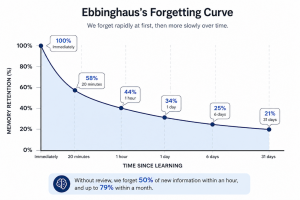
There are times when training doesn’t work and it is down to the wrong people – and I definitely have played my part in those – poor chemistry, ignoring my gut instinct, me being the wrong fit. I will 100% take that.
When it does work (and thankfully it works more often than not) a blended programme, where training is combined with sustained, structured coaching, consistently and measurably outperforms training as a single event.
These aren’t interchangeable options at different price points; they produce fundamentally different results from the same starting material.
Every serious piece of research into sales performance points to the same conclusion: knowledge fades within days without reinforcement, and it’s the reinforcement — not the initial training — that determines whether anything changes in how a team actually sells.
Training plus coaching produces roughly four times the result of training alone. In a controlled study of the same organisation and the same people, Olivero, Bane & Kopelman (1997) found training on its own lifted productivity by 22%. The same training followed by sustained coaching lifted it by 88%. (An old source but one that still holds credibility)
Without reinforcement, most of what’s taught is gone within weeks. Ebbinghaus’s forgetting curve** – another oldie from 1885 – states that we lose roughly half of new information within an hour of learning it if nothing reinforces it, with the loss continuing sharply from there. Modern sales-specific data confirms the pattern: the Association for Talent Development, drawing on Gartner research, found B2B reps forget 70% of training content within a week and 87% within a month.
High performers already build reinforcement in as standard, not optional. ATD research found 79% of high-performing sales organisations use structured post-training reinforcement — coaching, practice, follow-up — compared with just 46% of everyone else. That single practice is one of the clearest dividing lines between teams that grow and teams that plateau.
The top sales-methodology providers in the world have already moved away from the single-event model. Sandler states plainly that training investment is “next to worthless if it is not reinforced over time.” Korn Ferry (built on the Miller Heiman heritage) combines digital learning with ongoing field coaching rather than a day in a room. Challenger, RAIN Group and Richardson — the names that consistently top the rankings for B2B sales development — all sell reinforcement-based systems, not events.
My prospect has moved from wanting a ‘couple of days training’ into critical thinking around her sales team, the marketplace and the competition, trying to redefine what she wants from the team over the next 3 years, relative to both capability and capacity.
I’ll keep you posted.
Want the full picture? The Shift Control Guide to Sales Training sets out the research, the five-stage blended programme and what good looks like in a B2B salesperson. Get the free guide.
Thanks for reading
**Other more modern researcher now suggests that retention depends on other factors such as:
– prior knowledge before training
– emotional significance
– level of comprehension, absorption / retention
– retrieval practice
– sleep / recovery / nutrition
– gaps between learning
– context