
What’s in a brand name?
On Saturday evening, I watched the final minutes of the Monaghan v Roscommon game in a restaurant in the Moy, before heading down to the annual blessing of the graves.
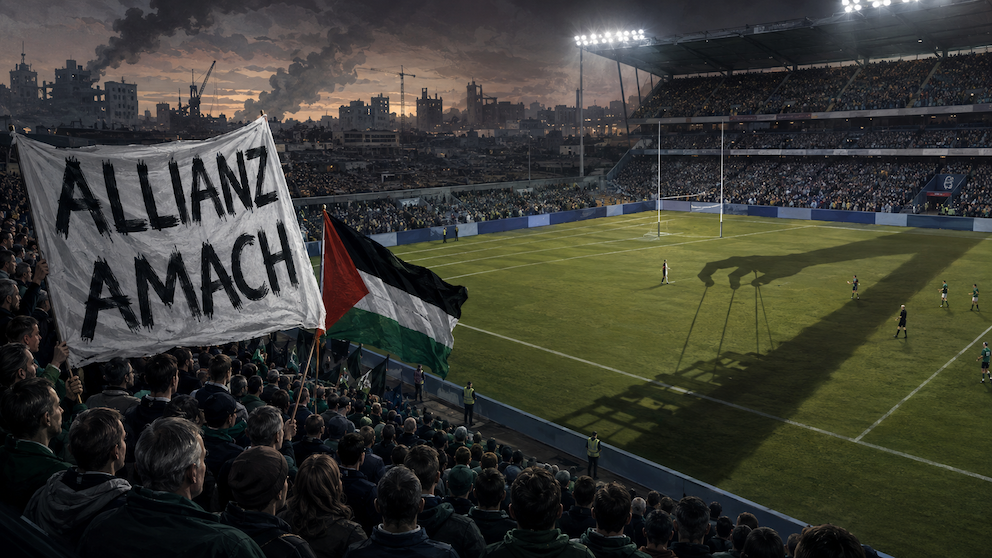
At one end of St Tiernach’s Park in Clones, fans had constructed a large banner with the legend “Allianz Amach”, designed to catch the attention of the watching TV audience.
This afternoon the very same banner was on display in Omagh, as Tyrone booked their place in the All-Ireland Quarter-Final with victory over Mayo.
Allianz has been a sponsorship partner of the GAA since 1993 and proudly appears as title sponsor of the league structures for football and hurling, as well as on broadcast campaigns and in programmes during the All-Ireland Series.
The banner is the fine work of Gaels Against Genocide in Gaza, a collection of GAA fans demanding that HQ cut all ties with the insurance company.
Support for Palestine amongst Irish people is long-standing and well documented, but the focus on Allianz only came about following a report published by Francesca Albanese, the UN Special Rapporteur, which named the German behemoth amongst insurers investing in “shares and bonds implicated in the occupation and genocide.”
Formal communication presented to the GAA resulted in a meeting between Jarlath Burns and Gaels Against Genocide in Gaza, a meeting which in turn led to an Ethics and Integrity Committee report where the GAA confirmed that it would retain the sponsorship on the basis that it was “ethically and legally bound” to honour the contract, and that “Allianz plc has no involvement with the IDF or corporate entities involved in the war in Gaza. Any such relationship is with a sibling or cousin company.”
“Ethically and legally bound.”
During breaks in the TV coverage, Allianz run their adverts in fulfilment of their ‘legal’ obligations under a contract that runs until 2030.
Ethically – it’s a different story.
Twelve months ago, I was introduced to a couple of apps designed to find those brands with strong links to land displacement in the West Bank, or with direct links to the Israeli war machine.
Courtesy of No Thanks and Boycott For Peace, I no longer buy any Alpro products (non-dairy milks, yoghurts) and have a watchful eye on numerous confectionery brands, Cadbury’s included, that have strong links to Israel.
Awareness, for me in this instance, is clearly more powerful than the act, but there are so many instances where better customer due diligence might result in different buying behaviours.
In bad company
A little bit of digging into the world of Allianz (courtesy of online agitator AliMacForever) paints a picture that should sit very much at odds with the position taken by the outgoing GAA President.
The company that proudly boasts insuring 90% of all Irish primary schools and 50% of secondary schools once insured the SS in Nazi Germany – its CEO, Kurt Schmitt, was appointed Reich Economics Minister when the Nazis came into power in the 1930s.
Of course, Allianz sits alongside a host of other brands (VW, Daimler-Benz (Mercedes-Benz), BMW, Audi, Porsche, Bosch, ThyssenKrupp, Siemens, Hugo Boss, Bayer, BASF, and Sanofi/Aventis) that can easily trace their lineage back to the Nazi regime.
Nothing new there, however Allianz is the one of these whose money is most directly tied to financing the current war.
PIMCO (Pacific Investment Management Company) is a US bond house founded in California in 1971.
Allianz SE bought PIMCO in 2000 for about $3.3bn, and it has operated as a semi-autonomous subsidiary ever since.
In her exposé of Allianz, AliMacForever explains that Allianz invests in 21 countries globally, including Italy, France and the USA. In the list of countries invested in, Israel is not mentioned, rather appearing under the “other” classification.
PIMCO, however, are forced to disclose publicly where they invest, but Allianz are not.
According to SEC filings, Allianz has lent Israel $1bn since 2023.
(An SEC filing is a formal document a company submits to the U.S. Securities and Exchange Commission — the federal agency that regulates financial markets and public companies in the United States.)
Changing the rules of engagement
In 2025, Allianz Global Investors scrapped two of its own ESG exclusion rules so that its sustainable (Article 8) funds could invest in defence and rearmament.
The two deleted rules were:
- The military equipment and services cap — a rule whereby their funds couldn’t hold companies earning more than 10% of revenue from military equipment and services.
- The nuclear weapons ban — a blanket exclusion on any and all nuclear-weapons-related activity. Allianz GI now permits investment in nuclear weapons activities provided they fall within the framework of the Nuclear Non-Proliferation Treaty (i.e. tied to the recognised nuclear-armed states).
A reinvention of their rules in line with the current malaise in the Middle East?
On top of this, Allianz has been outed as a principal institutional shareholder in Israel’s largest arms-maker, Elbit Systems, and is acknowledged as the insurer of Elbit UK, the company whose offices were targeted by Palestine Action.
Legally, the GAA might be bound to a contract that has another three-and-a-bit years to run, but as a major sporting property getting a replacement brand partner would not be difficult.
Shop Local
(In Derry, a local insurance company, FIND Insurance, has secured naming rights at both Celtic Park and the Abhainn Bheag facility, investing in GAA at both county and grassroots level and increasing their share of voice in the commercial insurance market.)
Ethically, the GAA ought to do and know better.
The war bonds, the stake in Elbit and the changes to the ESG strategy are all the outworkings of the Allianz parent company.
All profits flow upwards to the very same group that licenses its name to its Irish ‘sibling’.
The same company that once insured the SS now insures 9 out of every 10 Irish schools, whilst bank-rolling a genocide that includes the slaughter of thousands of innocent Palestinian children and the decimation of their education system, as well as their health and medical infrastructure.
The banners on display at the stadia in the north, the lobbying and media coverage by Peter Canavan and others, the thorough investigative work by AliMacForever and the boycotting of Israel-related produce may well be small gestures.
But those small gestures can eventually lead to bigger gestures.
Imagine the impact of the GAA severing its commercial relationship with Allianz.
Imagine the FAI refusing to play Israel in the forthcoming autumn soccer internationals.
“Bad men need nothing more to compass their ends, than that good men should look on and do nothing.”
A pot of yogurt or not, we all have a part to play.