

ARRRE all of your customers the same?
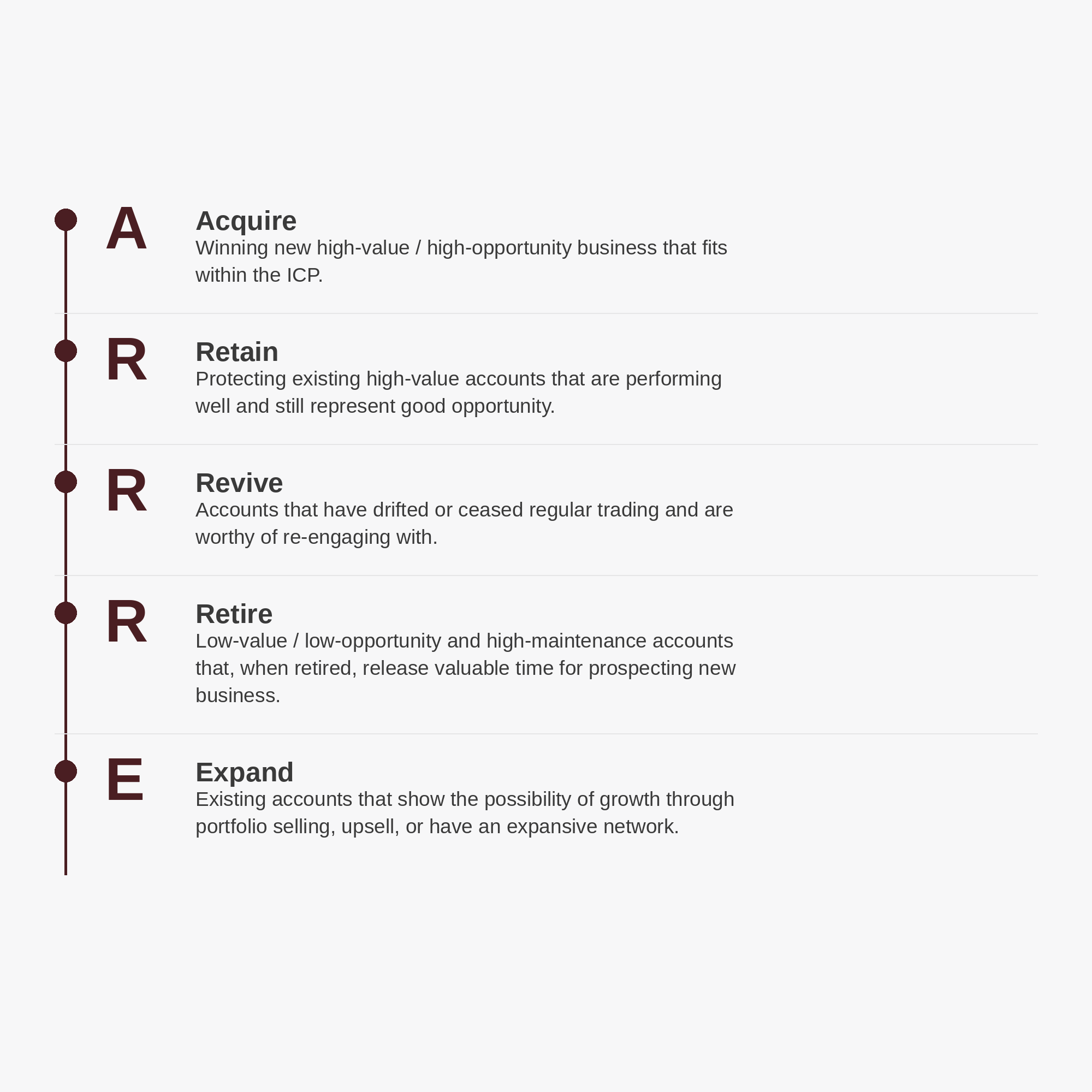
ARRRE is a customer account management model that places every account in one of five states, and is used to help sales teams with prospecting, account growth and customer management.
Why do businesses need a customer account management model?
It’s quite a natural thing to find all of your customers in the one place, often defined simply as ‘good’ or ‘bad’ customers. (When I say ‘in the one place’ I don’t mean in the CRM. I mean clustered together as ‘customers’ that don’t always get the attention they deserve.)
What your customers might share in common is the fact that you are:
- currently trading with them
- currently trying to trade with them
- used to trade with them
I created a simple acronym to give each customer type a short-form meaning.
As list categories go, it’s pretty straightforward, but even its simplicity can cause anxiety. Who in their right mind would want to RETIRE customers? If you’re going to let them go, how do you do that politely? And more importantly, how do you replace them?
All the wrong questions to ask.
What do the five ARRRE states mean?
Acquire: winning new customers – identifying target accounts that match the ideal customer profile, making contact and converting them into a first order.
Retain: keeping existing customers through regular contact, good service, account reviews, and dealing with problems before they lead the customer to look elsewhere.
Revive: winning back customers who have stopped buying or reduced what they buy, finding out why, and deciding whether and how the relationship can be restarted.
Retire: reducing or stopping sales effort on accounts that cost more to serve than they return, or have no realistic potential (low value, low opportunity, high maintenance). These accounts can be moved to a lower-cost way of serving them, or let go.
Expand: growing the business through existing customers: more products, more sites, more departments or a bigger share of their spend.
How do you decide which state a customer is in?
Customers and prospects fall into one of the following x/y axis scenarios:
- High Value & High Opportunity
- High Value & Low Opportunity
- Low Value & High Opportunity
- Low Value & Low Opportunity
Throw in a z axis for Maintenance and think about this one question:
Why work with customers that are LOW in Value and Opportunity but HIGH in Maintenance, when you could find more prospects who are HIGH in Value and Opportunity to replace them?
Frequently asked questions about the ARRRE model
Why would a business retire a customer?
Some customers cost more to serve than they return. If an account is low in value, low in opportunity and high in maintenance, the time spent on it is time not spent on customers and prospects with more potential. Retiring an account does not have to mean ending the relationship. It can mean moving the customer to a lower-cost way of serving them, such as online ordering or less frequent contact.
What is the difference between Retain and Expand?
Retain is about keeping the business you already have with a customer: regular contact, good service and dealing with problems early. Expand is about growing that business: selling more products, working with more sites or departments, or winning a bigger share of the customer’s spend. Most accounts need both, but the plan and the measure for each are different.
How often should accounts be reviewed against ARRRE?
At least quarterly. Customers move between states: a growing account can become an Expand opportunity, and a lapsed one can become a Revive target. Reviewing every account in quarterly business reviews, and in one-to-one coaching with each salesperson, keeps effort focused on the accounts that matter most.
How does ARRRE fit with sales training and coaching?
ARRRE is used in the Diagnose stage of a Shift Control programme to understand how a sales team is spending its time, and later as the basis for account plans. It supports two of the core B2B sales competencies: prospecting and account management.
Want to apply ARRRE to your accounts?
ARRRE is part of every Shift Control sales training programme in Belfast and Northern Ireland, and is explained in the free Shift Control Guide to Sales Training.
To talk it through, book a 30-minute call at cal.com/paul-shift-control.co.uk/quick-chat or email info@shift-control.co.uk.