

Known entities and unknown entities
For me, the three most obvious benefits of ceasing all social media activity are improved mental wellbeing, increased productivity, and not spending money on useless tat.
I can vouch for the first two, and my online purchases have seen a significant decline over the last six months.
I still get caught up in the occasional online purchase — mainly Amazon, or more likely eBay.
In the last month I’ve made a couple of fairly innocuous online purchases and fallen victim to two pretty serious scams.
On Wednesday, October 7th, my TV crashed while I was watching a movie. Searching online for a remedial solution, I came across a website called JustAnswer, which “connects users with verified professionals (medicine, law, veterinary, mechanics) for quick, reliable answers to specific questions” (their words).
I submitted my query, and for £1.95 was told my TV had a hardware issue and that my next step was to call the manufacturer’s customer service number.
All fair enough — except that on the following Saturday night, I noticed an alert for a £39.99 subscription payment leaving my personal account, to JustAnswer.
Fortunately, I caught it, and returned to the JustAnswer website to contact customer service.
That proved impossible. The only questions the AI bot would answer related to fixing a TV or simple DIY tasks. “Can I speak to someone in customer service?” was unrecognised, and with nowhere else to seek help on the site, I began to feel scammed.
I eventually found a customer portal and managed to cancel the subscription I hadn’t taken out, but my attempt to get a refund went nowhere.
I went onto LinkedIn (I don’t consider it social media, but it clearly is), searched for JustAnswer, found their page, and eventually spotted someone in Customer Success.
I explained my situation as succinctly as I could, and a woman called Wendy dealt with my request and refunded my money.
All good.
I told her there were fundamental flaws in the website’s UX, and that the subscription portal wasn’t working — pointing out an obvious issue for anyone who’d signed up for JustAnswer and might not have noticed the money being taken, as I nearly didn’t.
I asked whether she’d be able to pass this information to the tech department. She said no.
This concerned me. Despite her friendly “customer success” manner, she showed no interest in fixing the problem.
I started looking around the LinkedIn page, and that of their holding company, Pearl.com. Both companies are run by Andy Kurtzig.
Further exploration of the LinkedIn page turned up a post from another customer who had written, I paraphrase: “Why are you taking $150 out of my son’s account? It should only have been $1.95.”
I went back to my contact at JustAnswer and shared my concerns, which had escalated from bad UX to fraud.
My message:
Hi Wendy,
Thanks for coming back. I have to say that as a customer, the experience was terrible. I’ve identified some opportunities for your tech team to improve the experience, and also identified other customers who will have had an experience similar to mine.
The importance of trust in sales — irrespective of modality, sector, product or service — has never been under more scrutiny.
If I’m honest, I don’t feel the company has taken my observations seriously.
Your site auto-enrolled me into a subscription without any permission whatsoever. I was lucky to catch it. There may be countless others who weren’t so lucky, and you’re telling me nothing has changed on the subscription page or the contact page?
My initial thought when it happened was that I was being scammed, or that your site had been hacked, and I’m surprised you don’t see the severity of this.
Paul
I revisited the page the next day, only to find the customer’s post had been deleted.
My next message to Wendy:
“I’ve just noticed that posts on the JustAnswer LinkedIn page have been deleted — the ones where another customer made complaints similar to mine? Incredible. I’d like to escalate this, internally and externally.”
Wendy’s reply:
“Hi Paul,
Thank you for laying this out so clearly. I understand why the auto-subscription, the lack of visible contact options, and the later removal of similar LinkedIn posts have raised serious concerns about trust and transparency.
I’m sorry this experience has left you feeling your observations weren’t taken seriously. We take your feedback very seriously, and I will escalate your concerns to the proper teams.
Please let me know if you need further assistance from me.”
An interesting reply from the “customer success” champion, with more than a hint of “I am being held captive against my will. Please help.”
Some research backed up my theory that Wendy wasn’t free to act:
The Federal Trade Commission has sued JustAnswer LLC and its founder and CEO, Andrew Kurtzig, alleging that the platform deceived consumers into costly recurring subscriptions by advertising a nominal $1 or $5 fee to access its services.
The FTC’s investigation found that JustAnswer’s chatbot assistant, “Pearl”, told consumers during sign-up that they could “join JustAnswer for $5 (fully refundable)”, while the FTC alleges the company failed to present the actual monthly subscription terms clearly and conspicuously, as required under ROSCA (the Restore Online Shoppers’ Confidence Act) and Section 5 of the FTC Act.
Despite receiving significant consumer complaints and internal website testing that revealed widespread confusion about pricing, JustAnswer and Kurtzig made the purchase flow more deceptive rather than clearer. Kurtzig was named personally, not just the company: the FTC alleges he directly participated in the practices with actual knowledge that they were misleading, including declining proposed changes to website content and rolling back clearer versions of the disclosures. The complaint also notes that Kurtzig and the company were aware of the requirements of the FTC Act and ROSCA, and had previously faced government scrutiny of the company’s practices.
The suit was filed on 13 January 2026 in the US District Court for the Northern District of California, and seeks injunctive relief, consumer refunds and civil penalties. JustAnswer’s response was that it had “engaged constructively with the FTC for nearly three years” and was “disappointed that the agency has chosen this path”, while expressing confidence in its legal position.
A quick look at Trustpilot shows thousands of one-star reviews describing the same fate for customers trying to get their TV fixed.
Can you imagine how many people are using this platform without ever noticing the additional payments leaving their accounts?
At least I got my money back.
Lucky me.
Except — what are the chances of the same thing happening again, with a less fortunate outcome?
Quite high, actually.
So high, there’s a name for it.
Repeat victimisation.
A criminology concept describing how someone who has already been a victim of a particular type of offence has a higher-than-average chance of being victimised again, often by a similar method or within a similar timeframe. It’s well documented for fraud specifically: once someone’s details or payment habits have been exposed through one scam, they’re more likely to be targeted by another, since the tactics and audiences overlap.
The experience with Kurtzig’s company made me more curious about outgoings across my personal and business accounts, and it was while checking my PayPal account that I noticed a sequence of payments to a company called NordicaLab, which began earlier in the year with a £1.95 payment, followed by five payments of £39.95 over four months.
My JustAnswer experience wasn’t the first part of the repeat-victimisation pattern. It was the second.
I immediately reached out, via the email paypal@nordicalab.com, to ask a few questions about the subscription I hadn’t taken out.
Within a day, John at NordicaLab came back to reassure me that I hadn’t made a transaction on any of the six dates I’d highlighted in my original email.
I was relieved, and thought it would be a hop, skip and a jump to a full refund via PayPal, because, well, it was PayPal I was dealing with.
Not so.
Unlike Wendy at JustAnswer, PayPal have a ring of steel around their customer service, and the only way through is via an AI assistant, then into their call centre — a team of Indian and Filipino women, speaking fast, rarely listening, and occasionally slipping back into their own dialect mid-script.
A bit racist, Paul?
Or is it a genuine criticism of a customer service team delivering a script that seems to predate AI entirely?
I am expecting the full transcript of all the chat and messaging I had to endure over a three-week period. More of that later.
God, they’re good.
For nothing.
Except grinding you down, into submission.
Back in the day, I worked in a sales team trying to grow business for a tech start-up. Our strategy didn’t have a name in 2013, but today it’s called account-based marketing. It goes like this: decide on the target company, get an email, send an email, make a phone call, repeat.
One of the guys who worked for me, Sean, had a plan. He wanted to target Archie Norman, Chairman of ITV, but didn’t have an email address — so, using his initiative, he worked through all the possible versions:
anorman@itv.com
archie_norman@itv.com
norman.archie@itv.com
You get the picture.
Archie got the email, passed it on to his Head of Technology, and we got the deal.
I wondered if the same tactic would get me in touch with someone at PayPal.
Getting decision-makers’ names wasn’t easy — for a company of their size, there was a distinct absence of C-suite presence on LinkedIn. I got maybe five names and worked through 10+ variations of the email address.
They all bounced back: surname.fullname@paypal.com, initial_surname@paypal.com — all of them.
It takes a very special type of company to put a ring of steel around its decision-makers and executive team. A very special type of finance company. One that gives zero access to decision-makers.
I went back to LinkedIn and messaged their Head of Customer Success, Maeve Dorman. She replied to say she’d retired from PayPal — still proud to list the role and company on her profile, fair play to her.
More searching got me in touch with David Jones, Head of Consumer UK. Dave and I have been messaging back and forth. He seems like a decent person who’s done nothing to deserve this query — it isn’t his problem to deal with — but he’s been reluctant to give me a name or email that might actually help.
Anyway — NordicaLab. Who are they, and do they have a track record similar to JustAnswer’s?
From what I can tell, they’re a US-based operation, in Ohio, linked back to a company in Lithuania. Outside of that: no LinkedIn profile, no C-suite, no Daves, no Wendys.
Similar track record…
NordicaLab.com (16personalities.com, and the billing entity “Haur B.V.”) are identified in consumer reviews as parts of the same subscription-trap funnel, though this grouping comes from reviewer allegation rather than a confirmed corporate or legal finding.
According to one detailed account, on 16personalities.com (where I did my test) you take a free test, then are charged €1.95 for a full report, which you never receive. Different companies, NordicaLab.com and Trynourix.com, then collect €39.95, while TestLibrary.com behaves as though it has no idea its approach is anything but transparent.
Other reviewers describe the same grouping directly: Testlibrary.com, NordicaLab.com, 16personalities.com and Haur B.V. working together. The billing mismatch between the name consumers recognise and the name on their statement recurs across complaints — a direct debit is set up, and on PayPal the name shown is Haur B.V., while the contact email is NordicaLab’s.
The core grievance, repeated almost verbatim by dozens of reviewers across several countries, is consistent: pay £1.95 for the report, then get signed up to a four-weekly £39.95 subscription, with no mention of it at checkout — only in the follow-up email.
Similar MO to JustAnswer.
It’s PayPal’s attitude that disappoints most in this story. On multiple occasions they’ve sided with the vendor in a dispute, only to accept a re-challenge from me once I show them information I’d already shown them before.
This last week I’ve emailed NordicaLab several times, and they’ve sent back information that supports my position — but it’s been impossible to get that information through to anyone at PayPal.
On two separate occasions I’ve received an email from PayPal saying “this doesn’t fall within their US jurisdiction”, and when I tell them I’m emailing from the UK, I’m back in the loop again.
In the last ten days, NordicaLab has refunded two of the payments. They haven’t told me why, and neither has PayPal — who still refuse any meaningful dialogue with me.
With some help from Claude, I’ve been able to break down their correspondence and show it fails to address the core issue at every turn.
I found an email address via Reddit — executiveoffices@paypal.com — it appears there’s a whole cluster of people struggling to reach the Head of Customer Success.
I sent an email to that address, asking, paraphrased: “Now that I’m making you aware of NordicaLab’s fraudulent behaviour, what do you intend to do to protect your customers from future fraud?” I sent it to the chatbots and to Dave, Head of Consumer UK.
Nothing.
I haven’t bought anything via social media for six months, but I’ve still been scammed on numerous occasions — from local to international businesses.
And if you think PayPal and NordicaLab are hard to deal with, try getting the attention of Meta — Instagram specifically. As the customer, you do not exist.
Each of these platforms — and the financial providers behind them — should probably carry the message ‘buyer beware’.
Either the volume of customer queries is so overwhelming that nothing gets through, or the volume of people being scammed is so large that both vendors and financial providers are making a good living from it — and have no incentive to change anything.
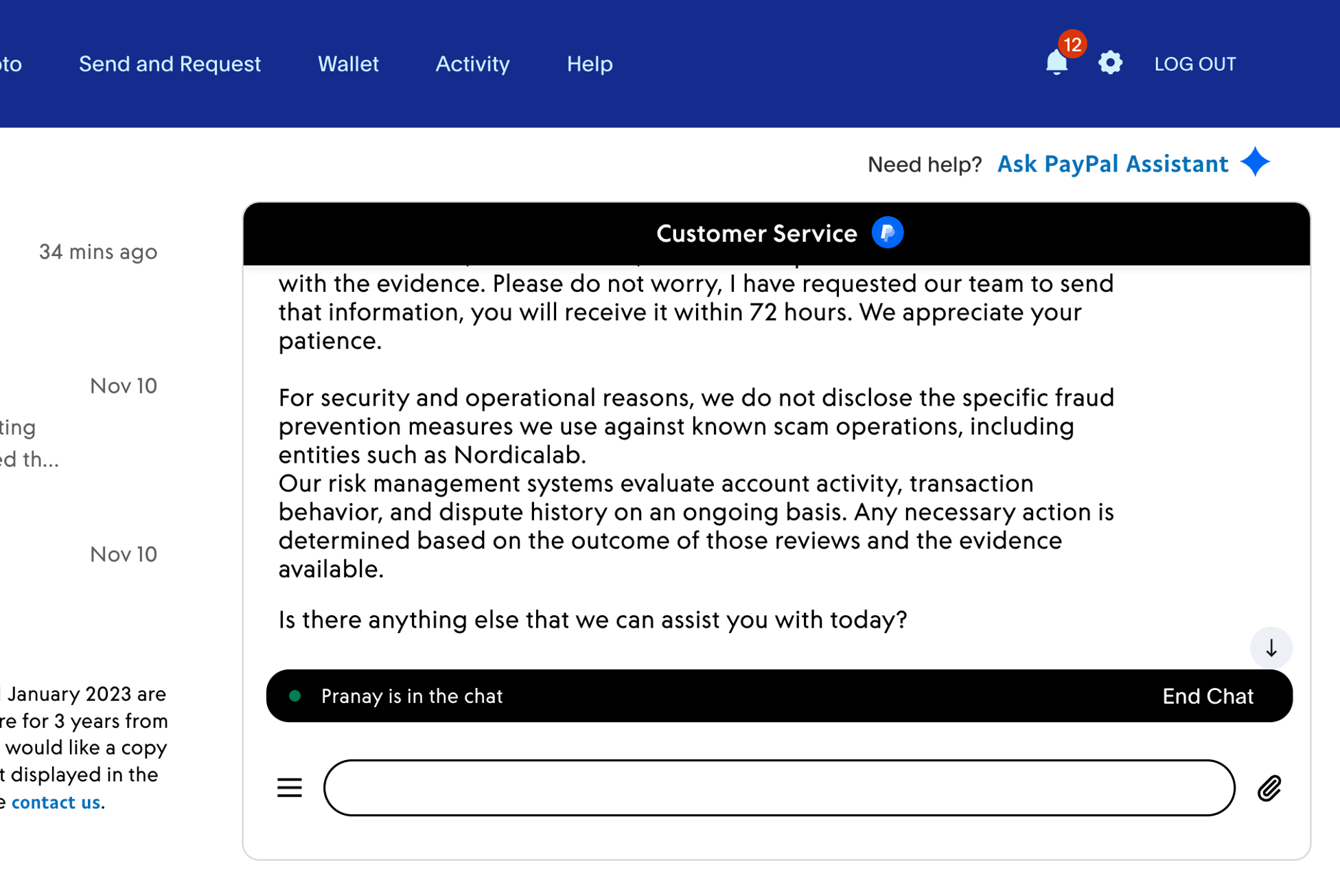
In my most recent engagement with one of the PayPal agents, the mask dropped completely – when i challenged them about their protocols to protect customers against these types of scams, the customer service adviser, Pranay, said:
‘For security and operational reasons, we do not disclose the specific fraud prevention measures w e use against known scam operators, including entities such as Nordicalab.’
‘…against known scam operators, including entities such as Nordicalab.’
‘…including entities such as Nordicalab.’