

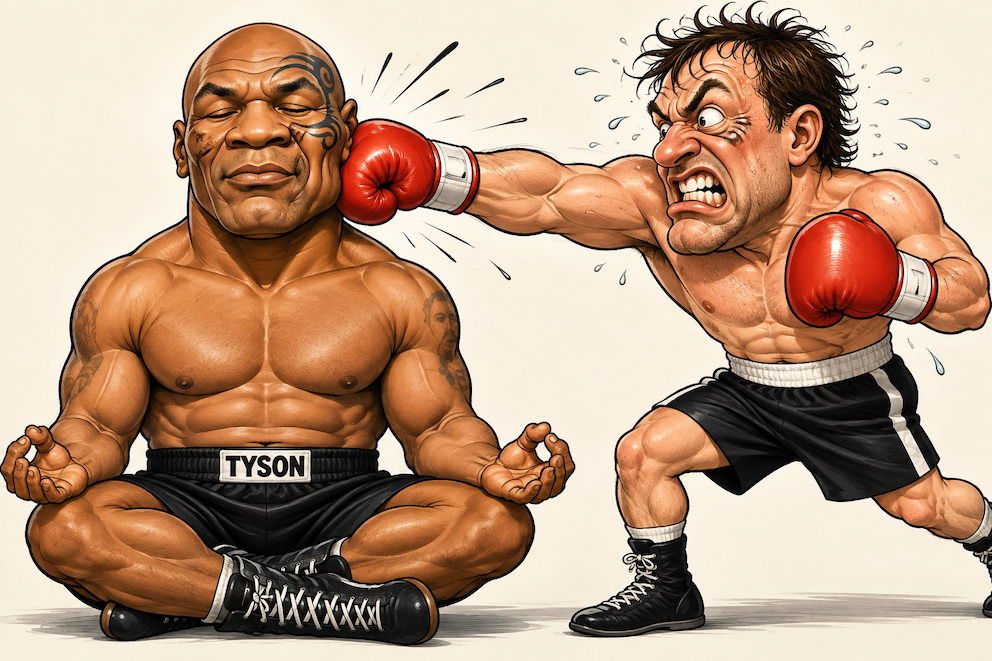
Putting a name on it, helps
Everyone has a plan until they get a slap in the mouth.
Paraphrasing the ultimate heavyweight to underline the importance of having a plan.
Eisenhower put it differently: “Plans are useless but planning is indispensable.”
To get through most stuff in life, you’ll most likely need a plan and if you want that to work, you’ll probably need a strategy too.
Whilst they might overlap, a plan and a strategy aren’t the same thing. A strategy is the reasoned choice of what to do and why it will work and a plan is the detailed schedule of steps that carries it out.
And when that punch in the face comes, then what?
First comes the ‘emotion’ – getting punched triggers the bodily response immediately and automatically, releasing adrenaline a spike in the heart rate, muscles tensing, possibly a reflexive flinch or aggressive posture, all before there’s any conscious acknowledgment of what’s happening.
The feeling comes after – the conscious experience of “pain,” “shock,” or “anger” is the brain interpreting that bodily state once it’s registered it.
Stimulus.
Emotion.
Feeling.
Then response.
Once the brain registers the feeling there is a gap, just before the response.
That gap gives you time to think about your response.
It’s not much time, but it’s time to think about your next move and in the case of Mike Tyson, he doesn’t need to think for too long.
But you might.
Being able to name the feeling makes your response controllable rather than automatic.
(Declan Coyle talks about this in The Green Platform.)
The brain can work faster on stuff it can name over the stuff it cannot name.
Lived experience has taught me that it is just as important to be able to name the emotional states we find ourselves in, alone at home sat by the light of a muted TV set as it is when we’re fighting for a unifying world heavyweight title fight.
In coaching, being able to name emotions is important and without trying to pretend I understand – or care to understand – the nuances of the prefrontal-neo-cortex-amygdala-bullshit – the naming helps to calm the whole show down.
Like pressing the RELAX button instead of the SELF-DESTRUCT button.
Emotional granularity (also called emotional differentiation) is the ability to identify and label emotional states with precision rather than relying on broad categories like “good,” “bad,” or “stressed.” Someone with high granularity can distinguish between, say, irritation, resentment, and disappointment – three states that a person with low granularity would all just call “feeling bad” or “upset.”
David Hawkins, in his Map of Consciousness, has created a ladder with 17 rungs, ranging from ‘Shame’ at the very bottom, all the way up to ‘Enlightenment’ – it’s not a scientific model nor backed with any kind of scientific research but it supports a principle.
The halfway point on this ladder, is ‘Courage.’
With each level, Hawkins places a corresponding ‘frequency,’ a ‘predominant emotional state,’ and a ‘view of life.’
Sat at the bottom are three closely associated emotions – shame, guilt, grief – and sitting just above is fear and anger.
Without giving time to process these emotions properly, it’s easy to jump to conclusions or to make no move whatsoever.
The predominant emotional state attached to ‘shame’ is ‘humiliation’ and the associated world view is ‘miserable.’
Grief brings the emotional state of ‘regret’ and a ‘tragic’ world view.
There’s a difference, albeit nuanced but there’s a difference.
Being sat on the bottom rung for any length of time isn’t fun but you have 2 choices – stick around or climb.
Knowing that you can climb and learning the skills to climb could all be part of a wider plan and a strategy.
That’s where coaching can help.
That’s where therapy can help.
And sometimes, with the right awareness, knowledge and support, that’s where you can begin to help yourself.
Thanks for reading
Feel the need to chat, drop me an email