

How negative self talk shapes your world
The older I get, the more I understand the destructive nature of self-chat.
That self-chat, or the internal narrative that pops up just when things seem to be going well, when you feel like you’re making progress in some part of your life — that voice from nowhere, reminding you of your fallibility and imperfections.
Or when things are going badly, and that voice appears just to compound the misery.
Consciousness didn’t make it onto the syllabus when I was at school. Nor was it there at university.
It’s only as you navigate life that you fully understand the power of the conscious/unconscious mind and its impact on who you are and how you view the world you live in.
When I began my coach training journey last year, I started to see things in a different light and from different perspectives, using my own lived experience and the shared experiences of others to better understand the emotional landscape that we find ourselves in.
In life, each of us gets a run of bad luck — stuck in a rut, disconnected, out of sorts, or in bad form.
Not just in sales or in work.
In life.
The thought–feeling spiral — and why it’s hard to shake.
It’s not always easy to put a name on that feeling, in part because, as we grew up, we were never taught to seek the name — just to ‘shake ourselves’ and get on with it.
If you can’t name it, if you don’t know what that thing is, that ‘feeling’ or ‘sensation’, what are you supposed to do with it?
Any thoughts you might have — about something bad or anxiety-inducing — lead to feelings.
Those feelings then feed back into thought, and so, once you’re anxious, anxious thoughts come more easily and cheerful ones feel unavailable.
Psychologists call this mood-congruent cognition — your current emotional state biases which memories, interpretations and predictions are within reach.
So an anxious feeling doesn’t just sit there; it recruits more anxious thoughts, which deepen the feeling, and round it goes.
A spiral of negativity that’s difficult to shake — and I can say that from experience.
Dr. David Hawkins, an American psychiatrist who spent his later years writing about consciousness, makes a simple enough point about this: your inner state doesn’t just colour your mood.
It changes what you believe is true about the world.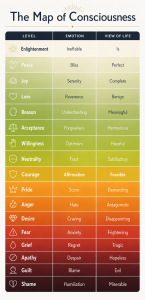
How your inner state shapes what you see.
Hawkins turned that idea into what he called the Map of Consciousness — a scale running from 1 to 1,000, with each rung representing a different state of mind. Shame and fear sit near the bottom. Courage sits in the middle, at 200, which he treated as a turning point. Enlightenment, of course, sits at the top.
Each rung comes as a package — shame comes with humiliation and a miserable view of life.
Grief comes with regret and a world that looks like a tragedy.
Guilt comes with a sense of blame and manifests as a particularly evil worldview, and so on.
The interesting claim — the one that made his 1995 book Power vs. Force a long-running seller — was that he could measure which rung you were on. Not describe it. Measure it, with a number.
Wizard or witch doctor?
So far so good? The handbrake for some is that Hawkins gets his numbers from muscle testing, or applied kinesiology.
Clearly not a scientific approach — and science can be important for many of us, myself included.
But if you take away the numbers, what you’re left with is a clear, recognisable description of how a state of mind governs what you can see.
From inside shame, the world looks miserable.
From inside fear, it looks threatening.
It’s not a measurement — it’s an observation, and it’s a good one. Most therapists and most contemplative traditions would recognise it.
The Map of Consciousness fails as a measuring instrument. But as a description of how differently the world looks depending on where you’re standing, it holds up better than you’d expect.
Hawkins labels Courage as the point of transformation — Courage is bundled with Affirmation and Feasibility.
That life has possibilities.
How many of us have had motivational phrases thrown at us — or have thrown them at others — without fully appreciating the power of the words?
They’re everywhere from all corners of philosophy, religion and even the odd barstool preacher
Just words, unless you sit with them, in the context of your own thoughts and consciousness.
I came across Hawkins’ Map of Consciousness recently, and some of the words started to make sense.
At last.
I see this pattern often coaching sales leaders and business owners across Belfast and Northern Ireland — usually SME founders and senior sales managers who are hardest on themselves in exactly the moments they can least afford to be. Naming the state you’re in is usually the first useful move, often before any sales coaching and training conversation gets anywhere near the tactical stuff.
Thanks for reading